Every media buyer remembers the spreadsheet: 20 tabs, 60 ad-copy variations, conditional formatting highlighting marginal CTR differences in pale green, and an account manager declaring a winner after 42 clicks.
I spent years building those spreadsheets. We billed clients good money to write four headlines, rotate them manually across ad groups, then check back three weeks later and discover that neither variant had reached statistical significance.
The math was always broken. In a standard Google Ads or paid-social account, manual testing can take months to resolve one creative hypothesis. By the time you identify a “winning” angle, auction dynamics have shifted, seasonality has flipped, and the platform’s delivery algorithm has already starved the challenger of traffic. You end up wasting your budget on creative testing that measures historical noise rather than genuine incremental conversion lift.
Automating creative testing with AI fixes the speed problem, but performance marketers hesitate for a legitimate reason: terror. Give an unconstrained language model free rein over an ad account and, eventually, it will hallucinate product features, generate compliance violations, or write copy that sounds like an overcaffeinated brochure.
The answer is not turning a generic prompt loose in Ads Manager. It is an autonomous testing engine that handles variant generation, statistical traffic routing, and winner promotion inside strict, non-negotiable brand guardrails.
Manual Testing Fails for Three Predictable Reasons
Running creative tests manually hits three structural bottlenecks within weeks.
First is human production lag. Writing 15 headlines and four descriptions for 10 ad groups is manageable. Testing five distinct value propositions, seasonal hooks, and audience pain points across 50 campaigns means generating hundreds of contextual permutations. Most teams run out of hours, so they test cosmetic tweaks: changing “Get a Demo” to “Book a Consultation” and calling it an experiment.
Second is analysis cadence. A human media buyer checks an account once a day or once a week. If an ad angle underperforms on Monday morning, it can keep burning cash until the next scheduled review on Thursday afternoon.
The third, and most expensive, failure is algorithm-induced traffic starvation. Modern ad networks do not distribute impressions evenly. Load multiple creatives into Google Ads or Meta and the platform’s internal multi-armed bandit algorithm tests them aggressively in the first few hundred impressions, optimizing largely for predicted click-through rate.
If Variant A picks up early engagement, the platform can channel 80% to 90% of impression volume to Variant A while Variant B starves. You end up with an ad that won because the algorithm picked a favorite before either variant logged enough conversions to establish a meaningful result.
You did not find the best message for your business. You found the message that satisfied an ad server’s short-term click prediction.

What an AI Testing Engine Actually Does
A useful system does more than produce copy faster. It tests different reasons to buy, routes traffic based on downstream outcomes, and promotes winners without waiting for a spreadsheet review.
Generate Competing Angles, Not Decorative Synonyms
When teams first try to automate creative testing, they usually paste a headline into a public chatbot and ask for 10 variations. The result is nearly always 10 versions of the same message wearing different adjectives:
- “Affordable CRM Software”
- “Budget-Friendly CRM Tool”
- “Cost-Effective CRM Platform”
That is not hypothesis testing. It is thesaurus management.
If your customer does not care about price, rewording your price pitch five times tells you nothing about why your conversion rate is flat. A real test changes the premise, not just the phrasing.
Autonomous variant generation works through structural deconstruction rather than synonym substitution. A purpose-built model breaks historical account performance into atomic components:
- The primary hook
- The core value proposition
- The numerical proof point
- The conversion barrier
From there, it generates divergent hypotheses across distinct psychological vectors. In a B2B SaaS account, that can mean testing an economic angle such as cutting license bloat by 34%, an operational-speed angle such as live setup in 24 hours, and a risk-reversal angle such as month-to-month contracts with zero onboarding fees.
By feeding historical CRM data and search-query intent into specialized models, the engine creates variants that challenge the underlying reason someone buys, not merely the grammar they read.
Allocate Traffic Toward Revenue, Not Lucky Clicks
Once variants enter the auction, the problem becomes balancing exploration with exploitation. You need enough data on new copy to learn something. You also need to avoid spending half the budget on an obvious dud because a rigid testing plan says “50/50.”
Manual testers often force that even split across ad groups. Native platform algorithms tend to make the opposite mistake, crowning a headline after a lucky burst of early clicks.
Bayesian multi-armed bandit algorithms sit between those two bad options. Anchored to downstream conversion actions rather than raw clicks, they shift impression share as data accumulates:
- Variants with a low probability of beating the baseline receive systematically less spend.
- Promising contenders receive more auction volume.
- New angles retain enough traffic to avoid being killed by one slow Tuesday morning.
The optimization target is not click-through rate. It is cost per acquisition, qualified pipeline, or closed-won revenue pulled from offline tracking and CRM integrations.
According to testing data from Admetrics, Bayesian frameworks reach statistical significance 60% to 80% faster than traditional frequentist testing while protecting budget from prolonged exposure to losing variants.

Promote Winners While the Signal Still Matters
When a challenger crosses a defined threshold, such as a 95% confidence level against the control, the system promotes it without waiting for human intervention.
In a legacy workflow, an operator downloads a spreadsheet, verifies the numbers, logs into the ad account, pauses the loser, and pastes the winner into live rotation. Autonomous execution completes that cycle when the threshold is met: the losing asset is archived, the winning copy becomes the champion across matching campaign themes, and the account updates its baseline CPA.
That creates a feedback loop manual management cannot match. When an angle wins, the system does not simply let it run until creative fatigue takes over. It extracts the semantic traits that drove the win: numerical proof points, loss-aversion phrasing, or speed-of-delivery promises. Those traits seed the next experimental batch.
The baseline keeps moving upward instead of waiting for the next monthly creative meeting.
Build the System in This Order
You do not need three data engineers or a pile of brittle custom scripts. You do need sequencing.
If you automate variant generation before you lock down conversion telemetry, the system optimizes toward whoever is cheapest to acquire: spam bots, job seekers, and accidental clicks on mobile app placements. That is not a model failure. It is a measurement failure wearing a machine-learning hat.
Start with conversion truth, then give the system permission to test.
-
Audit conversion truth before touching copy. Connect your ad platform directly to your CRM or backend billing system through enhanced conversions and offline conversion imports. The testing engine should bid and allocate traffic against qualified pipeline, sales calls held, or direct purchase revenue, never raw form fills or click volume.
-
Define the semantic boundary box. Feed the AI your brand guidelines, customer personas, pricing reality, and explicit negative-word libraries. If your sales team spends 30 minutes disqualifying prospects asking for free tiers, the copy should state pricing thresholds or exclude “free” and “cheap” from headline generation.
-
Deploy angle clusters instead of isolated variants. Group hypotheses into distinct thematic buckets: operational turnaround speed, economic return, compliance relief, ease of onboarding, and workflow elimination. Build three to four asset permutations per bucket so the system evaluates the premise before tuning line-by-line syntax.
-
Establish a statistical traffic floor. Configure allocation rules so every new angle receives a mandatory baseline of impressions, typically 500 to 1,000 impressions or at least 15 conversion actions, before the bandit algorithm can depress its bid priority. This prevents auction anomalies from killing an ad before it reaches real market demand.
Once those components are active, the machine does not need a human media buyer hovering over Campaign Manager. It monitors impression decay, detects when an asset’s conversion rate degrades against the category baseline, and deploys replacement assets from the hypothesis queue.
The practical point is simple: you stop treating creative testing as a monthly project and start treating it as an operating system.
Guardrails Are What Keep AI Useful
The genuine danger with AI ad generation is not slightly awkward copy. It is invented promises you cannot fulfill.
Tell an unconstrained model to write ads for a professional-services firm and it will happily draft headlines promising guaranteed outcomes or fictitious discounts. Google’s misrepresentation policies do not care that an algorithm hallucinated the claim. Unverified assertions can trigger ad disapprovals, throttle impression reach, or put an account at risk of suspension.
In finance, legal, and healthcare, an unpoliced generative model is an active liability.
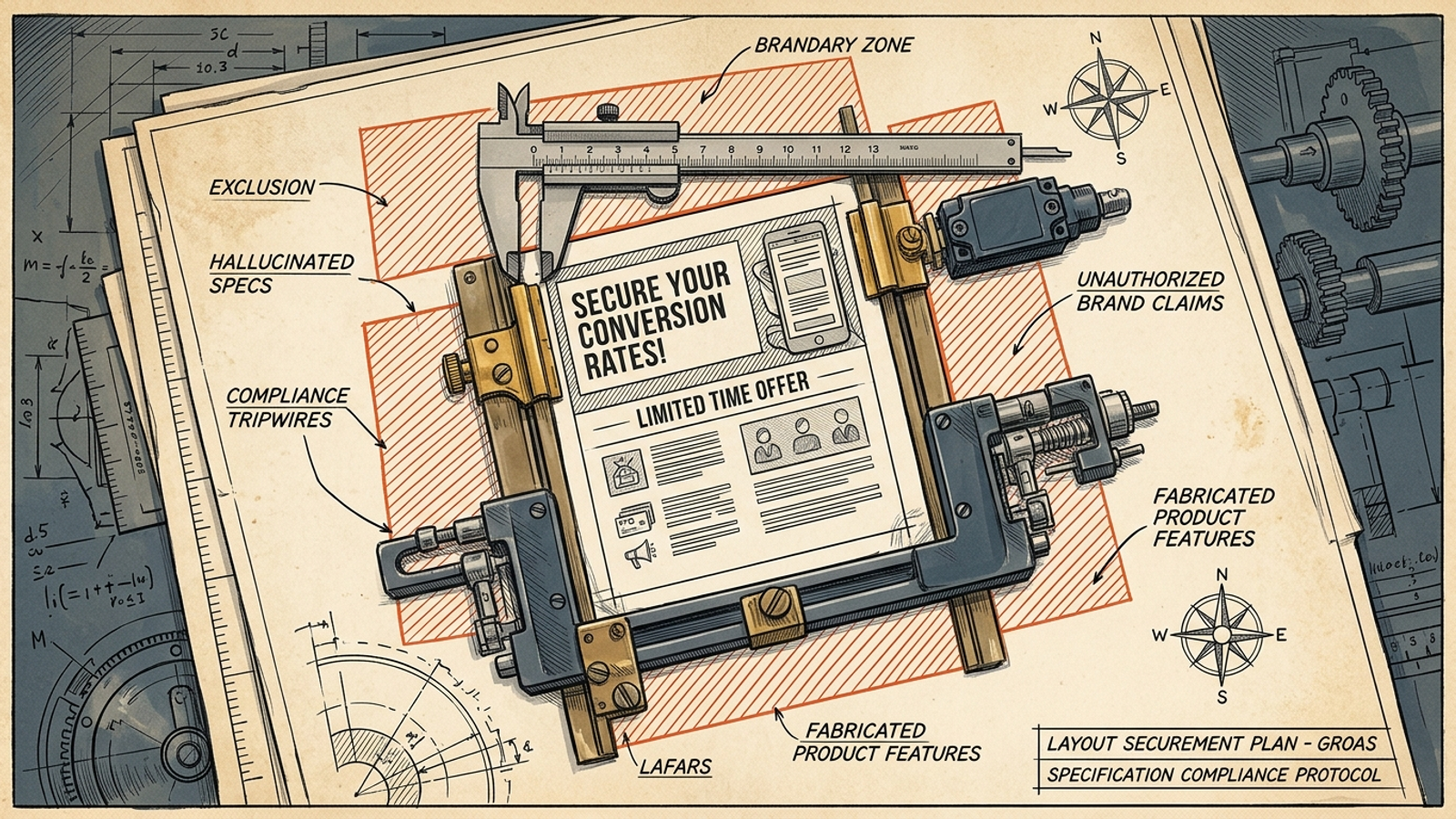
Brand control requires hard constraints, not polite prompt engineering. Asking a prompt to “stay compliant and sound professional” fails because probabilistic models drift under edge conditions. Production-grade creative automation puts generation behind a three-tier validation stack:
-
Lexical and regular-expression tripwires: An unbypassable dictionary of banned superlatives, competitor trademarks, unauthorized pricing claims, and restricted terms. If a candidate headline contains “guaranteed” or a competitor’s registered trademark, it is killed before entering the auction queue.
-
Fact-grounding assertion tables: The engine generates copy only against verified product specs, certified pricing tiers, and pre-approved outcome data stored in a universal context repository. If an exact metric, such as a 35% reduction in onboarding time, is not recorded in the truth table, the model cannot assert it.
-
Automated landing-page alignment scanners: The system checks that every value proposition or pricing figure featured in an ad matches the destination page’s live text. This protects against destination mismatches that Google can flag during automated ad reviews.
Tone control works the same way. Instead of hoping the model captures your voice, you quantify it through parameter bounds: reading grade level, noun-to-verb ratios, sentiment polarity, and active-voice percentages. If the brand forbids breathless hype, jargon, and unsubstantiated superlatives, those exclusions become hard filters.
The AI can explore dozens of creative angles within the perimeter. It cannot wander outside it.
Why Native Google Ads Tools Are Not Enough
Marketers often ask why they cannot simply rely on Responsive Search Ads and Campaign Experiments. The short answer: Google builds testing mechanisms to maximize auction liquidity and inventory utilization, not your net profit.
In an RSA, Google shuffles up to 15 headlines and four descriptions. Rather than testing coherent value propositions, it runs a black-box permutation exercise optimized primarily for predicted click-through rate. Asset reporting labels components “Low,” “Good,” or “Best” without showing the exact conversion rates or statistical confidence of specific headline combinations.
Worse, Google can penalize you with lower Ad Strength scores if you pin headlines to enforce logical messaging, even though Ad Strength measures adherence to Google’s input checklist rather than actual conversion yield.
Google Ads Experiments offer traditional split testing, but they force a rigid 50/50 budget split and demand weeks of manual setup, monitoring, and teardown. That operational friction is precisely why manual Google Ads management is failing modern advertisers: the auction moves in minutes while manual split tests drag across quarters.
Autonomous execution starts with the business outcome, not the platform’s preferred testing format. It tests structured creative angles, ties traffic allocation to verified downstream CRM conversions, and promotes winners across the account without waiting for the next reporting cycle.
| Testing Dimension |
Google Ads Native RSAs |
Google Ads Experiments |
Autonomous Execution Engine (groas) |
| Optimization Target |
Predicted click-through rate |
Account-level conversions |
Downstream revenue, SQLs, and target CPA |
| Testing Architecture |
Combinatorial asset shuffle |
Static 50/50 campaign split |
Dynamic Bayesian angle clusters |
| Execution Speed |
Platform-controlled pacing |
Manual weekly analysis |
Continuous 24/7 autonomous adaptation |
| Funnel Scope |
Ad copy only |
Single campaign duplicate |
Ad copy, bid guardrails, and landing pages |
| Outcome Transparency |
Vague labels (“Good”, “Best”) |
Aggregate performance delta |
Full action log with statistical reasoning |
Keep Humans on Commercial Decisions
Handing creative testing to an autonomous system does not mean vacating strategic responsibility. When brands get burned by automated ad setups, the root cause is rarely an algorithm miscalculating a confidence interval. It is an operator treating an ad account like a slot machine that does not require business context.
Specialized models excel at auction surveillance, semantic variation, and statistical traffic routing. They have no instinctive understanding of gross-margin pressure, customer-support backlogs, or unexpected inventory delays.
The human role shifts from mechanical execution to commercial governance. A senior strategist defines target unit economics, audits fact-grounding tables, and intervenes when operational reality changes.
If supply-chain bottlenecks push shipping turnaround from two days to three weeks, an unguided model optimizing for raw conversion rate may keep running speed-oriented headlines because they generate volume. A human steps in, suppresses turnaround-speed angles, updates the assertion table, and redirects testing spend toward reliability or product craftsmanship.
That is the division of labor that makes modern search marketing work. You do not need junior media buyers spending 10 hours a week rotating headline pins in Google Ads. You also do not need another dashboard nagging you with generic suggestions.
At groas, purpose-built models run ad copy, bidding, and landing-page testing autonomously 168 hours a week, while a named strategist owns the guardrails, direction, and commercial outcome on your account.
Creative testing stops being a sporadic quarterly experiment. It becomes an always-on engine that discovers what resonates, cuts what fails, and turns search spend into attributable revenue.