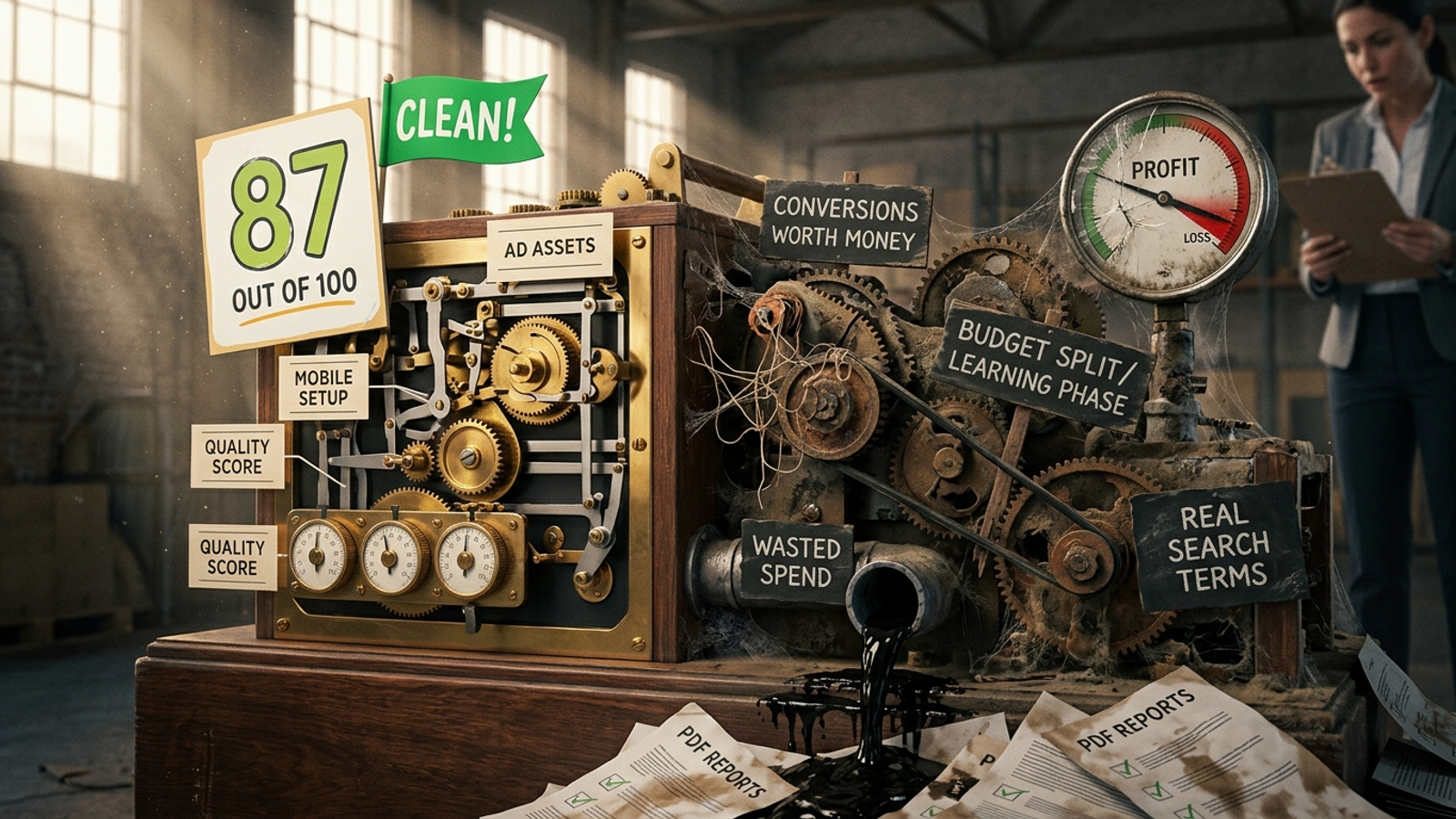
An AI Google Ads agency is a managed service provider for Google Ads services where software does the execution work, not junior media buyers.
Traditional agencies review accounts in weekly check-ins. Google ad automation services that are actually autonomous build, run, and improve bids, budgets, keywords, ads, and landing pages continuously — 168 hours a week — while a named human owns direction, guardrails, and accountability.
That is how groas runs: a fully autonomous growth engine for paid search and organic search. Hundreds of specialized models execute every action a marketing team would, at a scale no human team can, while a groas named account manager owns the direction, the guardrails, and the result.
What is an AI Google Ads agency?
An AI Google Ads agency replaces human hours with always-on machine execution.
Ad auctions change 24/7, but your team checks in once a day. Paid search generates more signals, decisions, and opportunities every hour than any team can process in a month. Bids shift, competitors move, and the humans managing it all work in weekly check-ins.
It is not a talent problem, it is a species problem.
An AI agency is built for that reality:
- Models work bids, budgets, keywords, ads, landing pages, content, and visibility signals continuously
- Every bid, search, competitor, page, and conversion creates another decision — the engine reviews all of them, not a fraction
- You set direction, budgets, and guardrails. The engine acts freely inside them and never beyond them
- Every action is reported in a weekly breakdown of what changed, why, what happened next, and where the strategy goes
Old school is 40hrs/week and the next check-in. groas is 168hrs/week and the moment a signal appears. Live same day, fully managed by the machine, with no dashboard, queue, or account layer for you to babysit.
What does a Google ad automation service actually do?
A Google ad automation service should do more than turn on Smart Bidding. Google's automation bids. It does not run your account.
A real automation service owns the work around the bid:
- Search intent: Understands the context behind every search and how it relates to your brand and offer
- Budget protection: Blocks irrelevant keywords, avoids costly bids, and uncovers cheaper high-quality traffic
- Copy and pages: Writes and tests ad copy and deploys dynamic landing pages that reshape around each search
- Opportunity discovery: Identifies new revenue channels and refines funnel architecture
- Optimization: Runs thousands of A/B tests simultaneously around the clock, like data scientists that never sleep
- Full funnel: Tracking, landing pages, offers, and the path after the click are part of the work — not your job
If a service only emails you suggestions or leaves tracking, pages, and structure to you, it is a tool. Not management.
What does a managed service provider for Google Ads services cover?
A managed service provider for Google Ads services should be able to perform any action a human campaign manager would ordinarily perform.
That means creating, pausing, or modifying campaigns, ad groups, keywords, ads, bidding strategies, target CPA or ROAS settings, budget allocations, audience targeting, ad scheduling, and any other campaign settings.
At groas, that breaks into five jobs:
- Build. Audits or rebuilds campaigns from scratch, including structure, keywords, ads, and conversion tracking tied to real outcomes.
- Launch. Live same day, with $0 onboarding fees. No 2-4 week onboarding queue.
- Run. Purpose-built models work the bids, budgets, keywords, ads, and landing pages continuously.
- Expand. Opportunity models find cheaper high-quality traffic and new revenue channels instead of just squeezing the same queries.
- Report. A weekly breakdown of what changed, why, what happened next, and where the strategy goes. You stay in control of budgets and limits.
Support for policy, competitor context, and direct platform insight is brought into the account when the work requires it.
What does a ROAS agency actually optimize?
A ROAS agency should optimize toward attributable revenue, not clicks, leads, or polished reports alone.
That is the split:
- Clicks and leads agencies optimize toward volume. CPA looks good, pipeline does not.
- ROAS-focused autonomous management optimizes toward qualified pipeline, closed-won revenue, ROAS, and cost per acquisition together.
Target CPA buys conversions at a price. Target ROAS buys revenue at a ratio. groas manages both, plus budget allocation, because pushing a ROAS target too high quietly kills volume and growth.
What buyers call "ROAS media" is usually the same question: who actually moves budget where it earns the most? The engine moves budget where it earns the most, continuously, instead of waiting for the next human review.
The proof is on the record across home services, hospitality, legal, ecommerce, and B2B: cut lead costs, scaled calls and bookings at the same budget, lower CPA in weeks, and owners firing $3,000 to $10,000-a-month agencies within weeks of switching.
Which setup fits your constraints?
Do not pick by feature list. Pick by constraint.
Budget
If human management burns your budget on the work itself, the meter runs whether performance moves or not. At $100 an hour, you pay for hours, not outcomes.
Autonomous management fits when:
- You spend enough that waste hurts, but not enough to justify a full in-house team
- You already fired or want to fire a $3,000 to $10,000-a-month retainer that reviews instead of executes
- You want $0 onboarding and work that starts now, not in 1-3 months
Team size
- Solo founder or lean team: You need fully managed. No dashboard to learn, no recommendations to interpret. You set guardrails, the machine runs.
- In-house marketer with no PPC specialist: You need the engine plus a named account manager who answers for the outcome.
- Agency owner: You need delivery under your name without specialist hires or capacity ceiling. The engine audits, builds, launches, and improves continuously while reports and strategy stay client-facing under your brand.
Use case
- Capture demand now: Paid search to show up at the exact moment someone is searching for what you sell. Best for local services, high-intent B2B, and ecommerce with clear search demand.
- Own the narrative: Organic search to become the brand buyers and models cite. Best when AI answers and competitors shape the shortlist before the click.
- Both: Paid captures, organic compounds. One machine behind both wins twice with the same business context.
If you have low search demand, no tracking, and no offer that converts, fix offer and tracking first. Automation scales what works — it does not invent demand.
How autonomous management works with groas
From the first click to the final conversion, the work is the same every week:
- Read every signal — bids, searches, competitors, pages, citations, conversions.
- Act inside your guardrails — adjust bids, budgets, keywords, ads, targeting, and pages the moment a signal appears.
- Protect the budget — block irrelevant queries and avoid costly bids before spend is gone.
- Test and expand — ad copy, landing pages, and new channels run as continuous tests, not monthly ideas.
- Report the outcome — what changed, why, what happened next, and where strategy goes next.
You never manage hours. You manage limits and direction. The machine outworks any team 168 hours a week inside them.
Apply for free trial to see it on your own account. If autonomous execution is not a fit, you will know in days, not quarters.